

Xfx Radeon R9 380x 4gb Benchmark
"Team Red" appears to have been invigorated lately, inspired by unknown forces to "have software very seriously" and better timely driver roll-outs. The company, which went about half a year without a WHQL commuter from 2H14-1H15, has recently boosted game-set up drivers almost launch dates, refocused on software, and is marketing its GPU strengths.
The newest video carte du jour from AMD bears the R300 series mark, from which we previously reviewed the R9 380 & R9 390 GPUs. AMD's R9 380X 4GB GPU costs $230 MSRP, simply retails closer to $240 through board partners, and hosts 13% more cores than the championed R9 380 graphics menu (~$200 after MIRs). That places the R9 380X in direct competition with nVidia'due south GTX 960 4GB, priced at roughly $230, and 2GB culling at $210.
Today, we're reviewing the Sapphire Nitro version of AMD's R9 380X graphics card, including benchmarks from Battlefront, Black Ops III, Fallout four, Assassin'due south Creed Syndicate, and more than. The head-to-head would pit the R9 380X 4GB vs. the GTX 960 4GB, something we've done in-depth beneath. We'll go into thermals, ability consumption, and overclocking on the concluding page.
Sapphire R9 380X 4GB Video Card Review [Video]
AMD R9 380X Specs & Sapphire Nitro R9 380X
| GamersNexus.cyberspace | AMD R9 380X | AMD R9 380 | AMD R9 390 | AMD R9 390X |
| Process | 28nm | 28nm | 28nm | 28nm |
| Stream Processors | 2048 | 1792 | 2560 | 2816 |
| Additional Clock | 970MHz | 970MHz | 1000MHz | 1050MHz |
| COMPUTE | 3.97TFLOPs | 3.84TFLOPs | five.1TFLOPs | 5.9TFLOPs |
| TMUs | 128 | 112 | 160 | 176 |
| Texture Fill-Charge per unit | 124.26GT/south | 108.64GT/s | 160GT/due south | 184.8GT/s |
| ROPs | 32 | 32 | 64 | 64 |
| Z/Stencil | 128 | 128 | 256 | 256 |
| Retentivity Configuration | 4GB GDDR5 | ii & 4GB GDDR5 | 8GB GDDR5 | 8GB GDDR5 |
| Memory Interface | 256-bit | 256-bit | 512-bit | 512-fleck |
| Retentivity Speed | v.7Gbps | 5.5-v.7Gbps | 6Gbps | 6Gbps |
| Memory Bandwidth | 182.4GB/s | 182.4GB/south | 384GB/s | 384GB/southward |
| Ability | 2x6-pin | 2x6-pivot | 1x8-pin 1x6-pin | 1x8-pivot 1x6-pin |
| TDP | 190W | 190W | 275W | 275W |
| API Support | DX12, Vulkan, Curtain | DX12, Vulkan, Mantle | DX12, Vulkan, Mantle | DX12, Vulkan, Mantle |
| Launch Cost | 230-$240 | $200.00 | $330.00 | $430.00 |
Note: Our R9 380X comes from Sapphire, who've overclocked the GPU core clock to 1040MHz from the reference 970MHz. The retention clock is pre-overclocked to 1500MHz against the 1425MHz reference. In that location is only a 4GB model of the 380X; a 2GB version does not be.
TDP of the R9 380X rests at 190W, equivalent to the reference TDP of the R9 380, though nosotros'll benchmark total organisation power draw in the last words of this review. The memory interface operates on a 256-bit wide omnibus and at five.7Gbps reference speed, outputting a memory bandwidth of 182.4GB/due south. Overclocked cards will slightly increase these numbers.
TMUs are the main increment over the R9 380, aside from a mostly higher clockrate from AIBs. The R9 380X is outfitted with 128 texutre mapping units (+16 over the 380's 112 TMUs), simply ROPs remains the same – 32 for each.
The same 28nm fab procedure we've come to know is still used in the R9 380X.
AMD R300 Series Architecture
AMD'south using the same architecture nosotros've seen a few times now, so no big news here. The only point that's worth reviving, though, is AMD's delivery to DirectX 12 and new APIs, like OpenGL Adjacent ("Vulkan"). This is something nosotros discussed with Chris Roberts of Deject Imperium games recently, for followers of Star Citizen.
In its 380X press materials, AMD brought tessellation and tiled resource management to the forefront of word. With DirectX 12'south takeover imminent, GCN architecture has the potential to make a stronger showing by way of its Asynchronous Compute Engines (ACE), designed for asynchronous shaders in DirectX 12. Asynchronous shaders overhaul the pipeline in a way that splices sizable workloads into multiple smaller parts. These are and so processed (asynchronously, equally the name would advise) to accelerate the pipeline, ensuring that no single resources is holding-up the processing of others. Larger resource tin exist worked on in the background while the small stuff gets managed throughout operation.

Support of Dx12's asynchronous processing isn't new to the 380X, but is a strength to which that AMD has aptly called attention.
Every bit stated in the initial R300 series launch, some overall changes take been made to the architecture to button this line across "rebrand" and into "refresh" territory. Primarily, those changes are summed-upwardly in the grade of thermal envelope reduction and a slightly bolstered clockrate over the R200 serial equivalents. This makes for reasonable gains in performance when cards are coupled with stable drivers – something we didn't have for the R9 390 at launch. We'll talk about AMD'due south driver condition further down.
Sapphire R9 380X Cooler Design

Sapphire's R9 380X uses the visitor'due south "Nitro" libation blueprint, introduced as a "gamer-targeted" brand alongside the R300 series. In Sapphire's vision, Nitro cards hit market close to MSRP and appeal most to gamers who don't care to do much tweaking or overclocking, not to say the cards tin't overclock – we'll exam that later – but they aren't targeted at overclockers.
The Sapphire R9 380X uses 4 copper heatpipes routed through an aluminum finned sink, adequately standard, and is fitted with two ~90mm fans for dissipation. The two fans take a sort of "inexpensive plastic" experience to them, but the cooler overall is relatively high-quality. This is something we discussed in the R9 380/390 Nitro reviews.
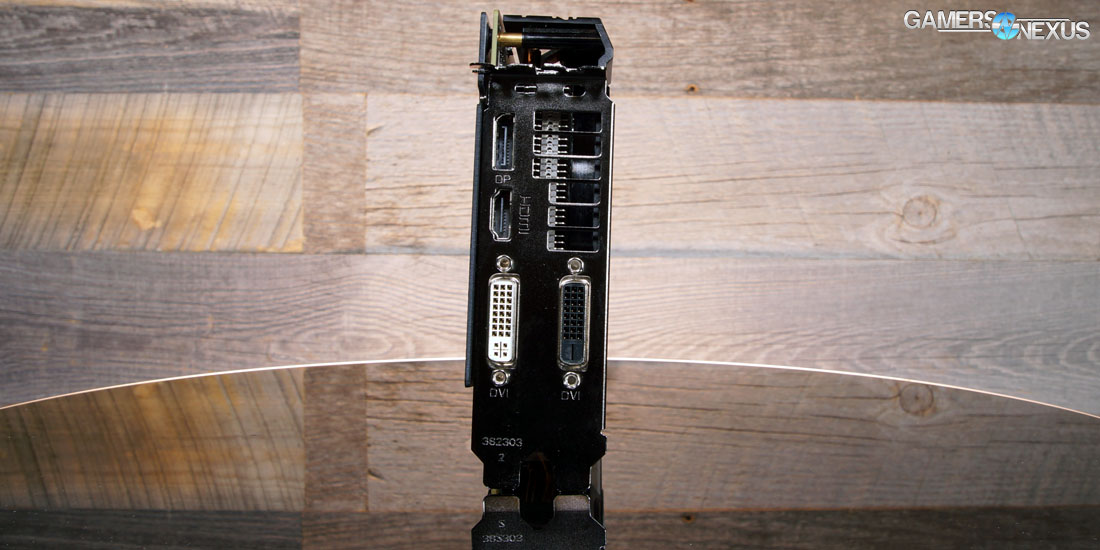
Sapphire'due south mounted a backplate to their 380X – with the words right-side up, fifty-fifty – and uses a futuristic white/blackness/gray color scheme. Nosotros like the overall styling of the backplate, but information technology is generally non of this website'due south interest to discuss aesthetics; we'll leave the residual to you, told through photos in the post.
Examination Methodology
We tested using both of our GPU test benches, as we are in the procedure of merging into a unmarried GPU exam bench. Both are detailed in the tables below. Our thanks to supporting hardware vendors for supplying some of the test components.
The latest AMD Goad drivers (15.11.1) were used for testing, except in the example of the Fury X and R9 380/390, which were all on loan and take not been updated since ~15.7. NVidia's 359.00 drivers were used for testing the latest games. Game settings were manually controlled for the DUT. All games were run at presets divers in their respective charts. We disable brand-supported technologies in games, like The Witcher 3's HairWorks and HBAO. Filigree: Autosport saw custom settings with all lighting enabled. All other game settings are defined in respective game benchmarks, which we publish separately from GPU reviews. Our test courses, in the event transmission testing is executed, are also uploaded within that content. This allows others to replicate our results by studying our bench courses.
Each game was tested for xxx seconds in an identical scenario, then repeated three times for parity.
Z97 demote:
| GN Test Bench 2015 | Name | Courtesy Of | Cost |
| Video Card | This is what nosotros're testing! | - | - |
| CPU | Intel i7-4790K CPU | CyberPower | $340 |
| Retention | 32GB 2133MHz HyperX Savage RAM | Kingston Tech. | $300 |
| Motherboard | Gigabyte Z97X Gaming G1 | GamersNexus | $285 |
| Power Supply | NZXT 1200W HALE90 V2 | NZXT | $300 |
| SSD | HyperX Predator PCI-e SSD | Kingston Tech. | TBD |
| Example | Elevation Deck Tech Station | GamersNexus | $250 |
| CPU Cooler | Be Quiet! Dark Rock three | Be Tranquillity! | ~$60 |
X99 Bench:
| GN Exam Bench 2015 | Name | Courtesy Of | Cost |
| Video Card | This is what nosotros're testing! | - | - |
| CPU | Intel i7-5930K CPU | iBUYPOWER | $580 |
| Memory | Kingston 16GB DDR4 Predator | Kingston Tech. | $245 |
| Motherboard | EVGA X99 Classified | GamersNexus | $365 |
| Power Supply | NZXT 1200W HALE90 V2 | NZXT | $300 |
| SSD | HyperX Savage SSD | Kingston Tech. | $130 |
| Case | Top Deck Tech Station | GamersNexus | $250 |
| CPU Cooler | NZXT Kraken X41 CLC | NZXT | $110 |
Boilerplate FPS, 1% low, and 0.1% depression times are measured. We do not measure maximum or minimum FPS results as we consider these numbers to be pure outliers. Instead, we take an average of the lowest 1% of results (i% depression) to show existent-world, noticeable dips; we then take an average of the lowest 0.1% of results for severe spikes. Anti-Aliasing was disabled in all tests except GRID: Autosport, which looks significantly better with its default 4xMSAA, and Black Ops III. HairWorks was disabled where prevalent. Manufacturer-specific technologies were used when present (CHS, PCSS).
- Battlefront test methodology can exist found here.
- Blackness Ops III test methodology is here.
- The Witcher three examination methodology is hither.
- Fallout 4 test methodology is here.
The Assassin's Creed: Syndicate methodology volition go live before long subsequently this post, but to epitomize, we tested these settings:
- 1080p / ultra loftier: MSAA2X + FXAA enabled. SSAO (not HBAO+) and "Loftier" shadows configured to ensure fair benchmarks.
- 1080p / ultra custom: FXAA instead of MSAA. SSAO. "Loftier" shadows.
- 1440p / ultra custom: as to a higher place.
- 4K / ultra custom: as above.
Overclocking was performed incrementally using MSI Afterburner. Parity of overclocks was checked using GPU-Z. Overclocks were applied and tested for v minutes at a fourth dimension and, if the test passed, would exist incremented to the next step. Once a failure was provoked or instability found -- either through flickering / artifacts or through a driver failure -- we stepped-down the OC and ran a thirty-minute endurance test using 3DMark's FireStrike Extreme on loop (GFX test 2).
Thermals and ability draw were both measured using our secondary examination bench, which we reserve for this purpose. The bench uses the beneath components. Thermals are measured using AIDA64. We execute an in-house automated script to ensure identical start and end times for the test. 3DMark FireStrike Extreme is executed on loop for 25 minutes and logged. Parity is checked with GPU-Z.
Thermals, power, and overclocking were all conducted on the Z97 bench higher up.
Video Cards Tested
- MSI R9 390X Gaming 8GB ($430)
- Sapphire R9 390 ($340)
- Sapphire R9 380 ($220)
- PowerColor R9 290X 4GB (Deprecated)
- XFX R9 285 2GB ($206)
- AMD R9 270X 2GB Reference (Deprecated)
- ASUS R7 250X 1GB ($117)
- NVidia GTX 980 Ti 6GB Reference (& SLI) ($660)
- MSI GTX 980 4GB Gaming ($515)
- EVGA GTX 970 SSC 4GB ($315)
- EVGA GTX 960 SSC 4GB ($225)
- ASUS GTX 960 Strix 2GB ($200)
- ASUS GTX 950 Strix 2GB ($170)
- EVGA GTX 750 Ti 2GB ($125)
- GTX 770 (Deprecated)
Source: https://www.gamersnexus.net/hwreviews/2193-amd-r9-380x-review-and-fps-benchmark?showall=1
0 Response to "Xfx Radeon R9 380x 4gb Benchmark"
Post a Comment